Use competing offers to understand your own price
Compare competing rental quotes for the same job to understand the full price, included services and whether your offer needs a change.

Two event rental websites list a hundred folding chairs. One shows $3.50 per chair and the other starts at $4.20. Only one price includes the cart delivery, and neither price shows what it costs to bring the chairs into the venue during a one-hour access window. A planner choosing between actual offers will need a more complete answer. So does a rental operator deciding whether their own price makes sense.
Comparing rental offers starts with making the job comparable. Record the items, times, service and terms a customer can see. Use those details to understand what each offer delivers, then compare the work and price with your own records. A useful comparison will tell you which price or description needs attention and give the office a better way to explain the offer.
Pick the booking a customer would reasonably compare
Choose a real kind of order the business serves frequently. It might be eighty folding chairs, ten round tables, set-up at a hall and collection the next morning. It could be a standard pickup of four lawn games. Give it a venue or pickup area, dates and expected handoff. An actual order shape makes price differences easier to interpret than a list of disconnected product rates.
Identify what the customer would consider equivalent. For seating, model, material, size and finish could matter. A generic white chair may fit a warehouse count and fail a planner’s design requirement. A photography package could vary in components or the kind of support included. Keep a short list of essential requirements and choices the customer could reasonably change.
Write down the conditions that make the booking difficult or easy. A ground-level dock delivery may need much less labor than a placement inside a second-floor room. A Friday pickup with return Monday can require more custody time than a day rate implies. If the customer is comparing a price with a limited appointment, note which part of the offer they may need to plan around.
Use comparable evidence and mark where it is incomplete. Public listings can describe normal rates and terms. A customer may share a quote they received if they are comfortable doing so. Use information you have permission to review. A sample total missing collection or availability may be useful context, with those gaps plainly identified. Avoid filling them with guesses and then treating the result as a real offer.
Build a comparison for the complete order
Record the offer date, equipment quantities and applicable price unit. Determine whether the amount applies to a single day, weekend, week or a named package. If the displayed rate is described as starting at a certain amount, record which conditions qualify or mark them as unknown. The same number per chair can lead to a different quote when the time period differs.
List included services and separately priced services. There may be pickup, curbside delivery, placement, assembly, staffed access, tear-down or collection. Give each a short explanation beside the amount. If you cannot determine whether a quote includes bringing tables into the room, leave that as a question. A professional comparison can show a gap without judging the other company’s service.
Separate order price from amounts held or paid at different stages. A quote can show a deposit toward the total and a later balance. A separate refundable deposit or authorization can affect the customer’s immediate cash or card requirements. Note the payment schedule and known conditions, and compare whether the prices include applicable taxes. Decide which total you can safely compare across both offers.
Record deadlines and restrictions the renter would need to know. A quote may hold its price for a defined time and require availability to be checked again before booking. An offer may use a particular pickup window or have different rules when the customer changes quantities. Keep the relevant terms visible so you can understand what the offer’s price commits the business to do.
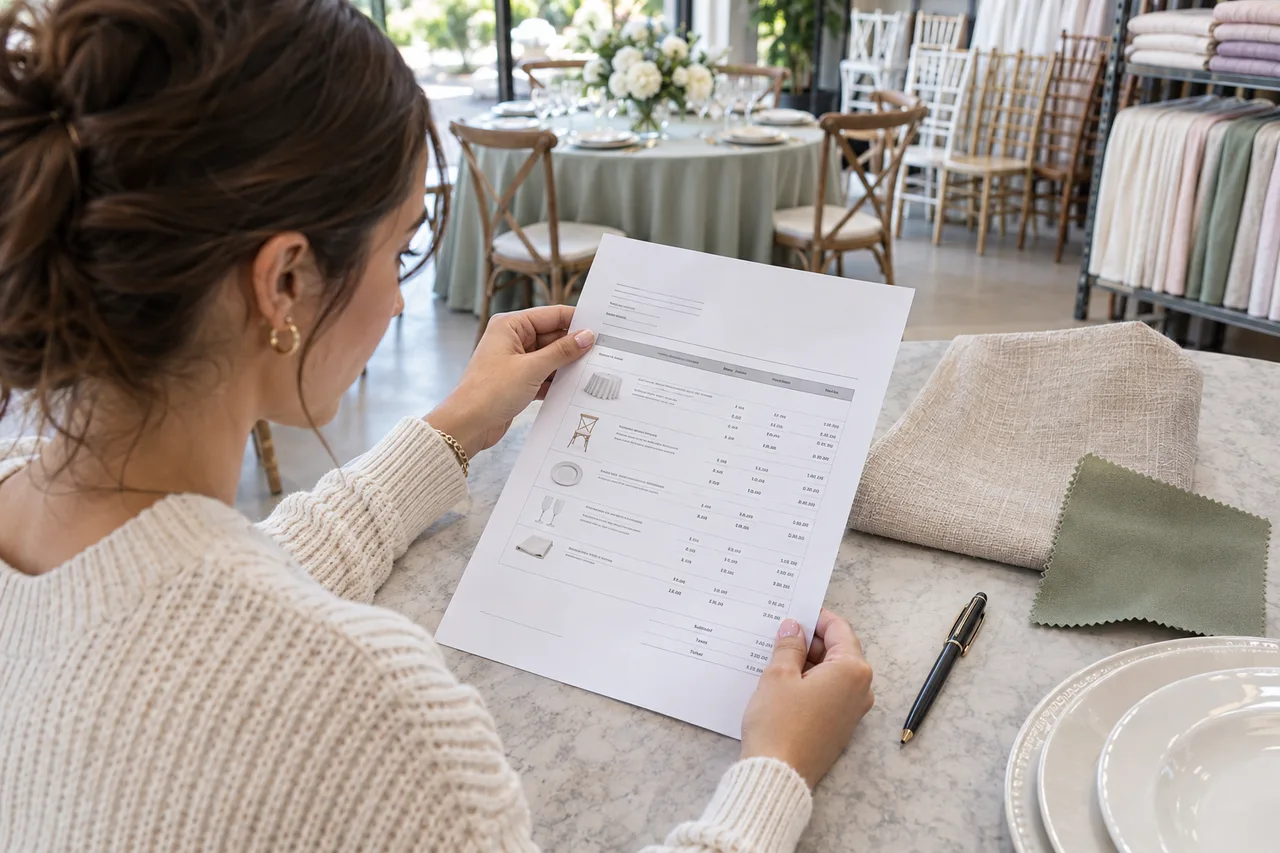
Check the service behind the visible amount
Open your own booking records for similar orders. Review actual handoff and route time, costs the business can identify, and questions customers asked during setup or return. Verify which work was included in the accepted amount. A price that includes a staffed carry-in can be compared with a curbside option once the extra work is visible.
Find what customers value in that difference. A planner who has their own crew may prefer a clean dock handoff. Another needs the rental company to place every table before a lighting team arrives. Both can be useful customers. If your business regularly offers the staffed service, say what it includes and offer a simpler handoff when you can serve it well.
Look for a gap between the stated price and your own costs. A delivery surcharge could pay for extra time at a venue, or it could obscure a basic cost that should be included in almost every offer. Ask dispatch and sales to show how often the task appears and how long it actually takes. This can clarify a price that the office regularly has to explain.
Compare availability with equal care. An inexpensive offer may be unconfirmed for the needed dates. An operator with more available stock might be able to commit immediately but have a different return window. Record what is known for the dates and service. A customer needs a price and a plan they can actually book.
Work a sample estimate through the full event
Imagine a planner needs eighty chairs for a weekend in a hall. One listing is $3.50 per chair. The inquiry confirms $280 for the chairs plus $90 delivery to the dock and $80 collection after the event, for a $450 total before any taxes. The planner’s volunteers will move the chairs inside. The delivery window is two hours, and the venue has agreed to receive them at the dock.
Your shop’s offer is $4.20 per chair, or $336, plus $165 for a timed delivery, placement and collection. That totals $501 before taxes. A separate $100 refundable amount is due according to the shop’s terms. The two prices differ by $51 for these examples. Their scopes also differ. The planner needs to decide whether they can be at the dock within the offered window and whether their volunteers are available to place the chairs.
Now consider a second offer you could make. If the shop can provide a $115 standard dock delivery and collection on the same dates, its total would be $451 before taxes. Staff can show the full choice between the timed placement and the simpler handoff. Before quoting the $451 amount, check that it fits the route and customer schedule and covers the actual work. The closest all-in price is useful only when the business can deliver the same scope.
Try the same comparison when the plan changes. If the hall loses its volunteer crew, the staffed option may become the more practical quote. If the venue gains a wider dock window, the basic offer may work well. Use the details the customer can verify. Your goal is to know which offer fits the event and to make the price difference understandable.

Handle an incomplete comparison with a small set of scenarios
Keep track of what you know and what you still need to verify. Suppose the public rate covers eighty chairs at $280, but the site lists delivery as “from $90” and gives no collection price. The $370 subtotal covers chairs and a starting delivery figure. It does not establish the full cost of the booking. In your worksheet, keep the confirmed number beside the missing conditions instead of filling them in with your own rates.
Make one comparison for the version you can verify and another for the practical alternative. Compare both shops on pickup if your customer can collect and each offer provides enough details. Review the staffed delivery as a separate choice where only your shop shows a firm offer. The customer can choose whether to ask the other business about the missing service. Your office can still explain what your quote provides and what the customer needs to arrange.
Record when each amount was seen and for which event. A public price might have been written for a different season. A customer quote may be valid only for a few days and have a date or volume condition. Check current details where you can before putting a number into a sales conversation. Keep the historical information as context for the decision it helped you make.
Be useful when a customer brings a screenshot. Ask which option they selected, when their event is and which services they need. Work from the amounts the customer is willing to share. Avoid asking for unrelated account details or making an assumption about another shop’s policies. A clear comparison often comes from getting your own offer complete and describing the decisions the customer can make with it.
Compare each offer with what it costs your team to perform
Open one order that used a basic dock handoff and one that needed staffed placement. Include the checks, prep time, loading, travel and work at the venue. Note when a job needed a separate collection, whether it could fit an existing route and whether the team lost time waiting for access. Put any estimates beside the facts the crew recorded. The cost difference gives you a basis for deciding whether the two services need different prices.
Suppose the $451 standard option would involve the same equipment and an easy stop on an existing route. An internal worksheet may show that the trip, handling and warehouse time can fit the stated amount. If a client requests a separate time the crew cannot combine with nearby work, price and schedule that service with the actual constraints. A quote the business can fulfill at the agreed price is worth more than one it has to revise repeatedly.
Review the equipment and people needed to offer each option every week. A shop may be able to deliver a low-complexity package on one busy date and lack a spare driver on the next. Give staff a way to verify capacity before sending the offer. If the package is only intended for defined dates, routes or quantities, show those terms early. The customer can then compare the options as they will actually be offered.
Decide whether a choice belongs in the catalog, on an estimate or in a case-by-case review. A common supported service can have a clear price on the storefront. An unusual access or setup job might need a quote. Give each path a useful description of items and scope, and explain when the amount becomes firm. Check the next five comparable offers to see whether people get clearer answers and the team has fewer unexpected tasks.
Decide which price questions deserve a change
Look for repeat evidence. One customer may decline a quote because a cheaper item fit their event. Several shoppers who independently compare the same item, time and service may reveal a meaningful gap. Track which offers were comparable, why the customer chose another and what the office could actually provide. Separate a better fit from a pricing problem.
Check what a lower price would require. It might be possible to serve a less costly pickup, combine a route or use an equipment package that is easier to handle. Estimate the work required and set the service expectations clearly. Reducing the same price without changing the costs can turn successful bookings into work that the business struggles to cover.
Consider whether the explanation needs more work than the amount. A customer who sees an unexplained fee for placement may be able to decide once they understand who sets the room and when. A product listing can show when the base rate applies and which service choices are available. Update the place people first compare the offers and confirm everything still adds up in the final quote.
Protect approved terms when changing the offer. Start future pricing at a defined point and make it clear which accepted quotes or current bookings use their existing terms. Give the office a way to review a customer’s past offer without losing the price figures on the current order. Customers need a consistent answer at the quote stage and after they book.
Use the comparison to improve sales conversations
Prepare a concise reply for someone who saw a lower listing. Ask which dates, products and services the other price covers if the customer wants help comparing it. State the amount for your own offer, including the relevant terms and services. Offer an accurate alternative if the business can provide one. A respectful explanation helps a planner choose without requiring you to criticize the other business.
Give the office a checklist of facts it can verify. Include the event dates, quantity, product version, setup or delivery arrangement, complete total and current availability. If a customer needs approval from someone else, send a quote that explains the choices clearly. Check whether your team can use the same description on a call, in the cart and on the approved order.
Record which discounts or alternatives helped. A later pickup might attract customers who have flexible dates, with no need to change every price. A more complete package could help customers who would otherwise purchase extra services separately. Watch whether the new offers affect crew work and stock. Confirm that the customer received what they accepted.
Keep your comparison focused on your own decisions. Use facts the customer would actually see, and revisit them when dates or services change. A short note with the example job and observed difference is better than a permanent claim about another operator’s rates, which can change. The office can still answer a question from the current offer it can serve.
Measure what happens after you change one offer
Choose a small revision and set a time to review it. You might show a low-complexity pickup offer beside a staffed delivery option for one product family. Track which route customers choose, what questions they ask, and whether each order can be fulfilled at the agreed amount. Compare orders with similar dates and service rather than looking only at the booking total.
Review accepted and declined offers. If people accept the price more often but still ask the office to explain the service afterwards, improve the description. If one option is popular and routes become harder to plan, check whether its timing or fee should change. Include what the crew did and the cost to provide it when evaluating the result.
Use the comparison when introducing new products. Start with real bookings and check which combinations the business will be able to serve. The price will be easier to explain when it describes a product, period, service and outcome the team can deliver. Keep good examples for the next person who prepares a quote and verify that the same options appear everywhere the customer shops.