Improving Quotes That Turn into Confirmed Rentals
Make estimates easy to understand, approve, and pay.

A customer requests eight tables and eighty chairs for a graduation party. You send a price list with twelve options and offer to answer questions. They reply that they need delivery but do not know what it costs. You ask for the address. Two days later you send a new total, but the email still fails to say whether the items are reserved. The customer books somewhere else, and the inquiry is recorded as “lost on price.”
A quote should give the customer enough information to make a decision and give your team enough information to honor it. Start with the request, confirm the facts that affect the job, and state the next decision clearly. The number at the bottom still matters. A useful quote makes it possible to assess that number alongside what will happen on event day.
Learn what has to be true for the rental to work
A strong quote starts with a few specific facts: the requested dates and times, the venue or pickup location, the anticipated quantity, and the kind of help the customer needs. An event date alone may leave out the period you have to reserve. Find out when the venue opens, when setup has to be ready, when collection can start, and whether customers can leave equipment overnight. A school fundraiser with an early setup and a hard collection deadline has different constraints from a backyard party that can accept a Friday drop-off.
Ask only the questions that can change the offer. Start with what you already know. If the customer gives you the date, address and guest count, do not make them repeat those answers on a different form just to request delivery. Fill in their details, ask about the loading point and check when staff can access the space. If a question is optional, let the customer know which quote assumption you will use if they cannot answer it yet.
A customer sometimes asks for products by a broad name. They may say “eight banquet tables” without knowing the size or expecting that their floor plan needs a particular layout. Ask about the function. If the tables are for seating, ask about seating count and space. If some tables are for a buffet or registration desk, identify those separately. Confirm the dimensions the customer can expect, especially when the difference will affect placement or number of chairs.
Write down the assumptions that can change the total
An assumption can be a useful way to keep a quote moving. For example, quote one accessible delivery point and a flexible pickup window if those are reasonable and clear. Mark the price or service term that depends on the assumption. Explain what will happen if the venue requires an earlier collection or a different access route. Give the customer enough detail to check the assumption with the venue without asking you to explain your entire dispatch process.
If a detail could make the job infeasible, ask before issuing a firm offer. A delivery address well outside your range or a collection time that nobody can staff is not a small adjustment. Give an honest next step such as a site review, a pickup option, or a different date. A quote that understates the uncertainty may close quickly and create a far more expensive conversation later.
Turn the request into an offer someone can compare
Group the quote around what the customer is buying. The customer should see products, related services, delivery and collection terms, and any selections they need to make. If several lines are part of one package, explain what is included. Show optional work as optional. A difficult layout should not force staff to hide extra labor inside an unexplained subtotal.
Use the same product labels the customer saw online or heard on the phone. Include useful variants such as color or size. When a package includes an accessory that matters to the event, list it where customers can see it. A spare item or setup instruction that only matters to the crew can stay in the booking record. The quote should explain the service without duplicating every warehouse step.
Work through a simple proposal
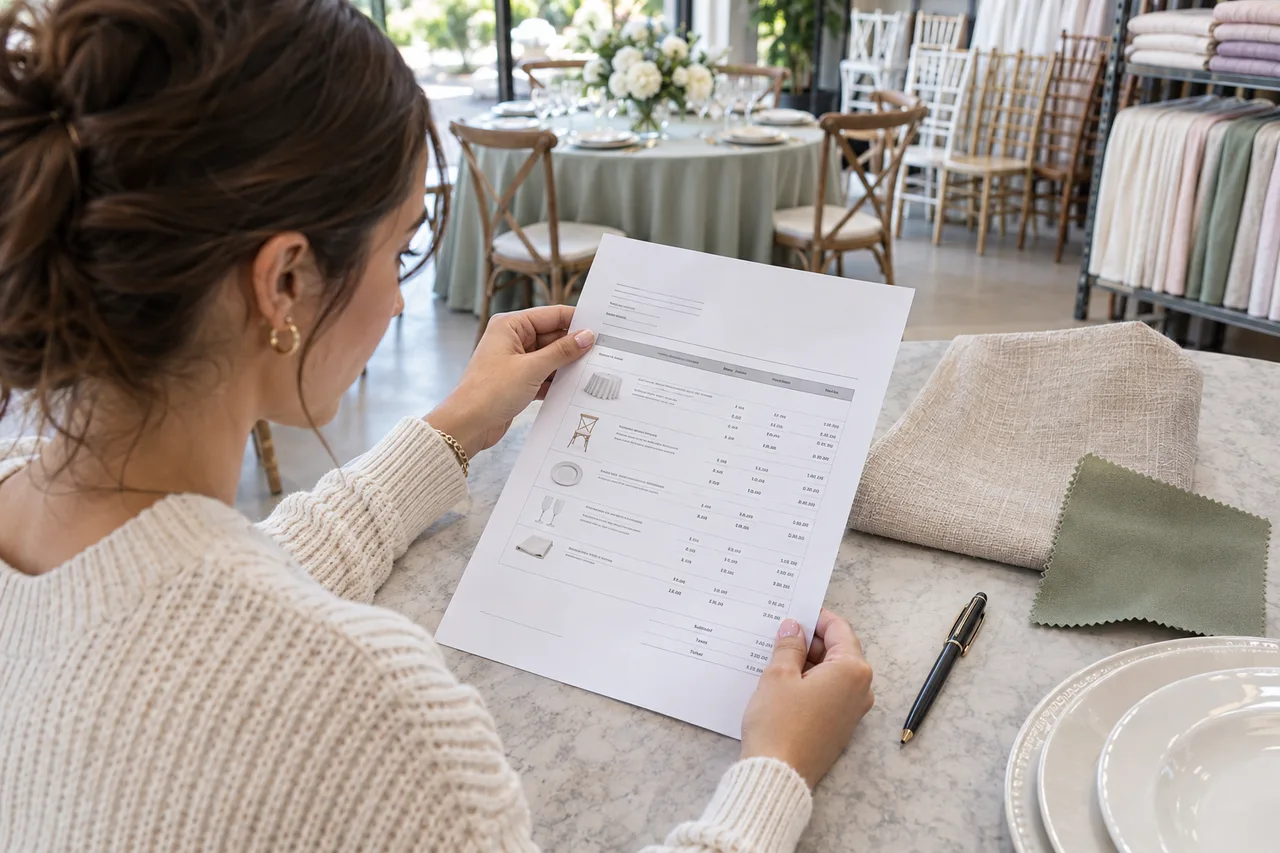
Suppose the graduation party needs eighty folding chairs at $3.25 each and eight tables at $12 each. The chairs cost $260, the tables cost $96 and the rental subtotal is $356. Standard delivery and pickup cost $120, bringing the example to $476 before applicable taxes. The customer can request placement for an additional $55. In the base option the crew delivers to an agreed ground-level point and returns to that location for collection. The placement option adds setting the tables and chairs in the agreed layout.
If you quote both options, show their totals at the same point in the document and specify which option is active on the acceptance link. The base total is $476 before taxes and the placement total is $531 before taxes. Keep a note about how the layout will be confirmed if they select placement. Quote changes should update the accepted total and the work order together. If the crew is told to place the furniture and the office still sees the standard fee, the process needs a better handoff.
Offer alternatives that resolve a real decision
A useful alternative addresses a known concern. If the customer is asking whether they can collect the gear, show how pickup changes the price and what vehicle and return appointment they would need. If budget changes the appropriate product mix, show one practical arrangement that uses fewer items while still serving the event. Extra options can make an easy decision harder when the customer has already given you the size, color and delivery preference.
Explain why an alternative is available. “We can supply gray folding chairs on Saturday; the white chairs are unavailable for your delivery window” is specific and gives the customer a way to decide. If an option is still waiting for availability or a supplier, mark that status. An alternative should be a real offer or a clearly stated inquiry, with an owner for the next check.
Be explicit about availability and acceptance
Decide what sending a quote does to inventory. A quote may describe current availability without consuming it. A short hold can reserve gear until an exact deadline. A confirmed booking reserves equipment for the agreed interval. Tell the customer which stage applies and what is needed to reach the next one. Use an actual date and time zone for expiry, especially for quotes sent near a weekend.
A sample acceptance instruction might say, “Review the equipment and the delivery window, select placement if you want it, then approve and pay the booking amount. We’ll send your confirmation when the reservation is secured.” If your process requires a signature or dispatcher approval, include that condition. Show the amount due now, the amount due later, and any other expected step in the same customer view. The goal is a single decision, even when your office tracks several stages behind the scenes.
Keep the price valid and the promise accurate
Measure validity from the business constraints that matter. A price may be firm through a particular date while stock remains available. A temporary hold can expire sooner because someone else has requested the same equipment. If you offer both, separate the two dates clearly. Never tell a customer that the reservation is confirmed solely because they received a proposal.
Test what happens after the quote expires. The customer should see a clear way to request a refresh and learn whether anything changed. Staff should know which facts to verify before renewing it. If delivery availability is tighter than equipment availability, remember to check both. The updated quote should show any revised date, quantity, price or service term before payment.
Follow up around the customer's decision
Set a follow-up based on when the customer can make a choice and when your business needs the answer. A next-day check can be sensible when a customer is comparing quotes for an event next week. A longer planning cycle may need a reminder after a venue appointment. If you promised to hold stock until Friday, follow up before the hold expires and state the actual cutoff. Keep the message proportional to the work needed.
A short follow-up can say, “I held eighty gray chairs and eight tables until Thursday at 5 p.m. The quote includes delivery and pickup. If the venue confirms the loading point, you can use the approval link to reserve the order.” A message like this explains why you are contacting the customer and leaves them with a specific action. If they already approved or declined, stop the follow-up.
Record the open question in the quote history
Give the salesperson a place to record why the quote is waiting. Examples include the venue confirming access, the customer choosing a size, or the office checking a second truck. Put the next action and date on the record. A week later, another employee should be able to continue the conversation without asking the customer to repeat it. Avoid a generic status such as “pending” when it hides who is supposed to act.
If the customer needs a phone call, ask what would make a short conversation worthwhile. A complex setup may benefit from talking through photos or a floor plan. A basic seat count might be resolved with one line in an email. After a call, send an updated written offer or a concise recap of material changes. The crew will need the agreed version when they load the order.
Track what happens between sent and confirmed
Use a few practical measures before deciding that conversions are a pricing problem. Track valid inquiries, issued quotes, accepted quotes and confirmed bookings. Record when each stage happened. If the same request gets three quote versions, count it as one opportunity. Otherwise, sending revisions makes your conversion percentage look lower even when the work improved the chance of booking.
Break out the common reasons for unresolved quotes. A customer may find another vendor, choose a different event date, run out of reply time, or need something you cannot deliver. Ask politely when the reason is unknown, especially if the person planned with you for several days. Keep an “unknown” category instead of assigning every silent inquiry to price. Review a few full conversations before drawing a conclusion from a summary number.
Read a small sample without overreacting
Suppose you receive twenty requests this month. Sixteen are within the dates and service area you can cover. You issue fourteen quotes and confirm seven. In those cases, half of sent quotes become bookings. The four requests outside scope and the two feasible requests you never quoted tell you about intake and capacity. They are separate from customers who reviewed a complete offer and decided against it.
Take the next ten quotes and test one improvement where you have a specific hypothesis. If prospects routinely ask for the delivery price, make the fee and collection terms easier to find. If office response time is the issue, set a review schedule and see how long it takes to issue a usable offer. If venue access is causing repeated delays, ask the relevant question in intake and compare how many subsequent revisions are needed. Keeping the rest of the offer stable makes the result easier to interpret.
Hand the accepted offer to the crew
When a quote becomes a booking, verify the actual products, quantities and service terms against the dispatch and packing records. An accepted placement fee matters only if the crew knows where the tables go and when the venue opens. An approved substitution needs to appear in the packing list. An extension to Monday can affect other bookings, so make sure it is reflected in the reserved inventory interval.
Assign someone to review exceptions. If a quote was accepted but a payment is still in progress, tell staff which steps they can begin. If the customer asks for an extra table after acceptance, follow the same change process and record which version they approved. Preserve the payment record and update the amount owed. The customer should be able to identify the current version and the operations team should know which equipment to send.

Check that changes continue through to fulfillment
Trace a sample order through quote, payment, booking, staging and return. Add two chairs after the first revision and ask someone else to find the updated number. Check the item count in the booking, the new total in the payment view and the quantity on the truck sheet. If the systems disagree, identify which record owes the others an update. Run that exact issue again after changing the workflow.
A test like this also helps you see whether you are asking for the same approval twice. If the customer selected the layout and accepted the total, the office can confirm the operational details using that accepted version. Ask for another decision only if something relevant changes, such as schedule, price or layout. This keeps the process easy for customers while giving the team a clear record.
Review your next five quotes before changing the whole template
Pick one straightforward order, one delivery with access questions, one order with an optional service, one case where availability is tight, and one previous customer request. For each, verify these points:
- The event date, rental interval, and delivery and pickup windows are clear.
- The products and quantities are specific enough to compare.
- The customer can tell which services are included and which require a choice.
- The price, booking payment, and remaining balance agree with the checkout or invoice.
- The availability status and any deadline are clear.
- The customer has one next action and knows how confirmation will arrive.
- The office can trace the accepted quote to the final dispatch and packing instructions.
If one check fails, fix the part of the process that created it. Rewording a proposal cannot resolve missing delivery coverage. A faster checkout cannot make up for an unclear promise. Find the relevant handoff, run a sample again and measure how customers respond over normal jobs. The quote is doing its work when the customer knows what they are agreeing to and your crew sees the same job when it is time to deliver.
Give repeat customers a fresh quote when the job changes
A returning customer may ask for “the same setup as last year.” Use the earlier order as a reference, then check which parts still apply. The venue may have changed its access hours, the product may have a new name, or the customer's event may have grown. Send a current quote that shows the quantities, time windows and price. If the original layout still works, mention that so the customer can confirm quickly.
This is also a useful way to review stale product names and instructions. If staff has to translate every item from an old quote before issuing a new one, add a reference note for the current catalog or update the proposal template. Keep the old quote readable so you can explain prior terms without letting it make commitments for the next event.