Growing a Bounce House Rental Operation
Expand carefully by balancing popular inventory with safety and delivery capacity.
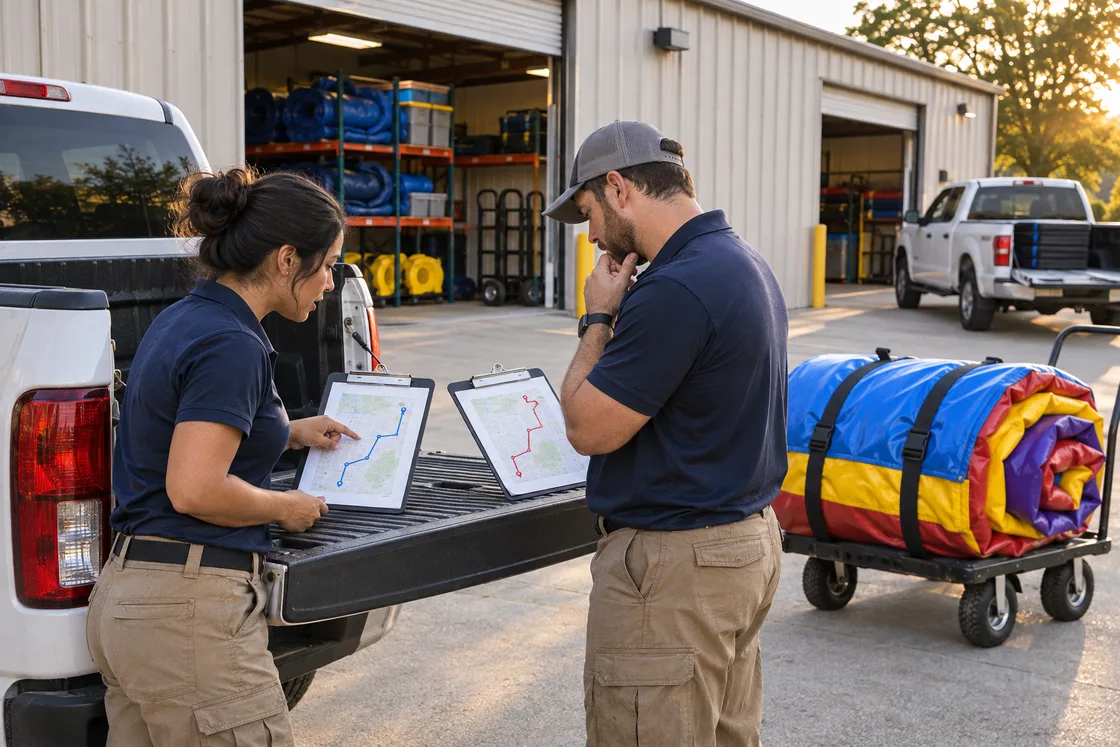
The week a bounce house business runs out of Saturday slots can feel like the week it needs another truck. Look closely at the orders before making that purchase. You might have five structures ready and only one person qualified to release a setup. The expensive part of adding capacity could be a second lead, enough warehouse space to turn over equipment, or keeping a spare crew available when the weather moves three pickups to the same time. A second truck fixes only the problem of moving equipment.
Plan the expansion around a second crew that can work independently. Begin by documenting the jobs the first crew can safely complete and where they already rely on the owner. Then let a trained second lead own a small group of routes, with the equipment, records and decisions available at both trucks. This guide follows that transition from a single crew working out of a small shop to two crews with a shared calendar and warehouse.
Count the work that stacks up at the same time
Take six representative weekends and reconstruct the load on the busiest blocks. On a paper timeline, mark vehicle loading, agreed arrival window, inspection and handoff, return visit, unloading, cleaning, drying and return to available stock. Mark the people and equipment occupied at each phase. Include the hours it takes to turn around a job that returns wet or needs repairs and a follow-up inspection. Bookings listed side by side in a calendar can hide overlapping work that happens before and after the advertised event.
A typical Saturday might have two morning deliveries, one midday setup and three afternoon collections. The busiest block may be the end of the day, when two venues both need the equipment removed by closing. A prospective job with delivery near the first stop and pickup an hour before it may fit better than an order across town with a narrow collection window. Take into account where a second worker is needed, whether any stops need additional time for access, and what happens when a location is not ready for the crew.
Tag inquiries you had to decline and give each a reason. Try categories such as unit occupied, vehicle occupied, no qualified crew, outside route, access requirements, unresolved site conditions or too little time to process the order. A declined request for the only slide you own is different from declining a compatible unit already in the warehouse because your lead is at another setup. Record date and neighborhood separately from the customer's contact information in any planning report. After a month or two, you can compare which constraint cost you the most plausible jobs.
Use at least one quiet week in the count, too. The busiest weekend reveals the upper limit, but normal weeks inform the payroll and vehicle commitment you can sustain. Ask what work the second crew can take over when promotion, weather or seasonality reduces orders. Useful hours could include venue walkthroughs, equipment inspections, stocking, training or servicing customer collections. The business case should still show how that time fits around the roles you already pay for.
Define what a crew can take on without calling the owner
Create a route profile for each class of job you offer. A nearby single-unit backyard delivery could have a different staffing and vehicle profile from a festival order with several structures, venue-specific documentation and scheduled supervision. Decide the experience required to lead each class and which jobs need the owner's involvement or another qualified person. Base those limits on the work itself, the applicable rules and your actual procedures, then reflect them in how orders are assigned.
Write the decision points that routinely slow a setup. They may include a site that differs from what the customer described, an access route the crew cannot safely use, an unsuitable setup area, unavailable site documentation or weather outside the equipment's limits. Tell the lead which source of instructions to consult, which changes must be referred, and how to stop. If the lead pauses a job, the office should handle the next customer conversation and record whether the job gets rescheduled, moved to a suitable site or cancelled under the agreed terms.
Use the manuals for the exact equipment, your insurer's requirements and rules that apply to the event and location when you train or write procedures. The U.S. Consumer Product Safety Commission publishes guidance on inflatable amusement devices. Use it as one reference alongside instructions and requirements specific to the equipment and venue. Keep the latest approved setup and operating instructions available to both crews even if a cellular signal at the venue is poor. CPSC’s inflatable amusement device safety guidance
A capability checklist can be tested with ordinary questions. Can the lead find the records for the assigned unit without calling the owner? Can the lead tell when a job described as a simple drop-off has become a venue installation with different requirements? Can the office see the lead's decision before taking another booking that assumes the vehicle is clear? Ask the lead to explain the answer in their own words and practice a handoff during a training session.
Design the warehouse for two departures
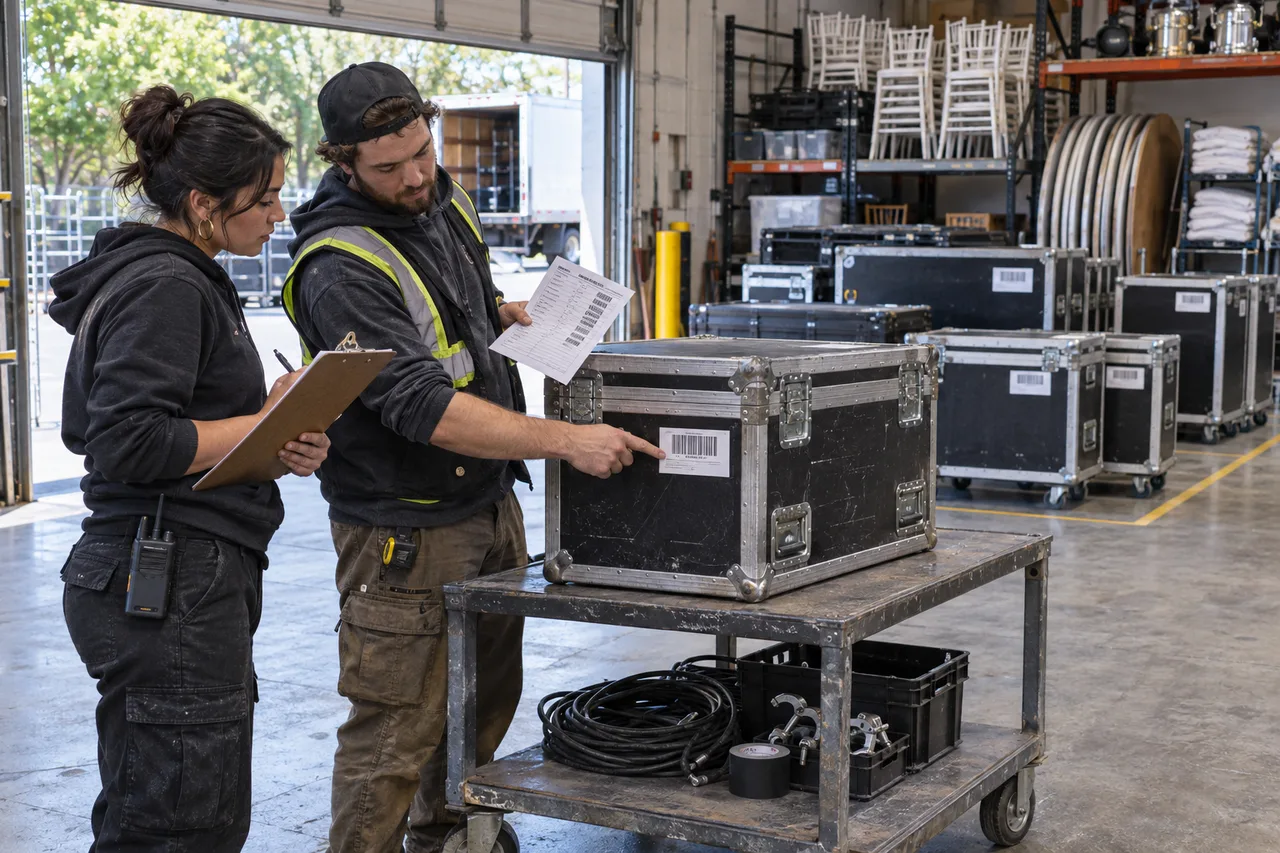
A single crew can compensate for an improvised warehouse by remembering which cart lives behind the tables. When two crews arrive at once, memory becomes a competition for the same loading lane and tools. Give each upcoming route a staging spot and a defined time to use the loading door. Keep ready equipment apart from returns in inspection, units waiting to dry and equipment held for repair. The calendar should reflect whether each unit can be booked and loaded, regardless of where it sits in the building.
Each order manifest should name the specific unit or permitted substitution, the agreed equipment and the supplies or accessories its setup requires. Use labels the crew can read on a folded unit and on the packaging that stays with it. The return record should show who placed it into inspection, where the included items went, and who can make it available again. Add a repair hold when a unit needs work so another coordinator cannot book it just because the inflatable is physically back at the shop.
Run through a common conflict. The first truck arrives at dusk with two returns. The second lead plans to prep an early route and needs the bay. Decide where the first crew places wet or dirty units, who sorts accessories, and which manifest the lead consults before unloading the next order. If a particular unit from the first truck is promised the next morning, the office should know immediately when that unit cannot be cleared in time. Identify the available substitution and who contacts the customer if the order needs to change.
Inspect the mix of shared and dedicated items. Some supplies can be stocked per truck, with a refill checklist on return. Others may be expensive, need inspection or be specified for certain units. Reserve those separately when creating routes instead of expecting crews to transfer them on the fly. On a wet weekend, compare how many units can actually be spread out, cleaned and dried at once. Growth might require a covered processing area before it requires additional equipment storage.
Train a second lead with observed practice
Choose a training sequence your operation can staff. It may begin with riding along on routine routes, then preparing paperwork and loading, then rehearsing site decisions with a qualified lead, and finally taking responsibility on a supervised job. Select representative examples such as a venue with a short load-in window, a customer who asks for a change, and a unit that must be returned to inspection. Record the date, unit or job class and evaluator for each demonstrated competence. Attendance shows someone was there. Observed practice shows how they did the work.
Give the trainee exposure to the administrative parts of the result. Running a good route includes being able to document a delay, update dispatch, explain a change to the customer, and collect the required site or handoff record. If a call comes in for a request the lead cannot approve, rehearse what dispatch says and which facts it needs to proceed. Keep emergency and stop procedures available to everyone. A trainee's willingness to ask for help should be part of a working process.
Build a short handoff between the leads at dispatch. One crew may finish early and the other could be delayed at a venue. The dispatcher needs to know which vehicle can do the next collection without sending a lead away from active duties. Include schedule changes and ETA notes in a shared record so there is a single current plan. If the leads communicate directly to coordinate a stop, agree who makes the corresponding change in the office schedule.
Keep the first few parallel runs small. For early shifts, assign the new lead a route with familiar units and service areas and enough time between stops to recover from ordinary delays. Avoid changing vehicle, venue category, unit mix and the number of early starts all at once. Schedule brief reviews after both trucks return. Write down what the lead decided independently, which decisions still required a phone call and where a checklist or software view would aid the next run.
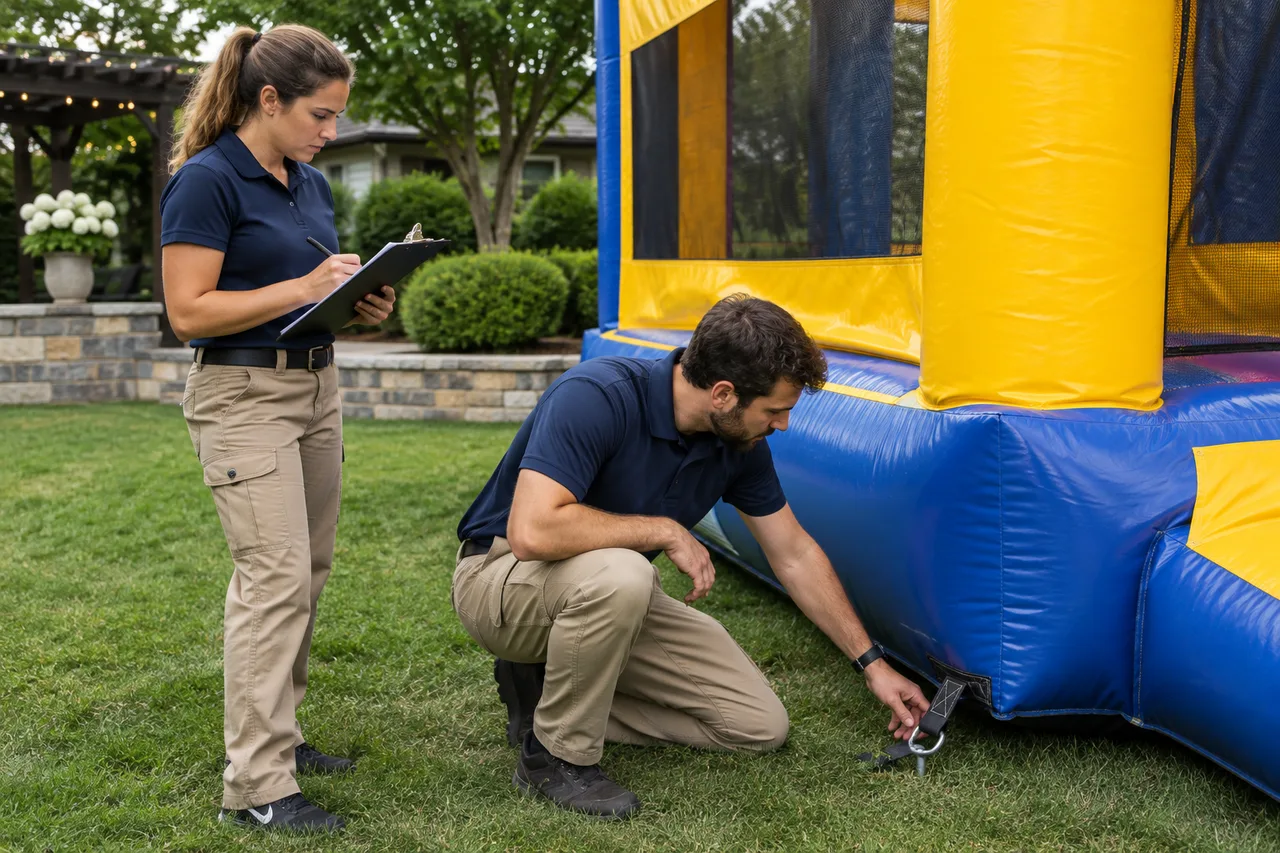
Price the extra work using contribution and actual hours
For each candidate booking, estimate the equipment revenue and direct costs under a two-crew schedule. Count paid hours at the warehouse and venue, reasonable payroll costs, vehicle and travel costs, cleaning, any staffing for supervision that the job needs, processing fees and routine wear. Use the route that the second truck would actually run, which may include more miles or more warehouse waiting than your current average. Track replacements, maintenance and insurance separately as recurring costs the expanded operation must support.
For illustration, consider a package that brings in $480 before taxes. You estimate $140 of field labor and loading, $55 of travel and vehicle cost tied to the route, $45 for cleaning and wear, and $15 for payment fees and supplies. That leaves $225 to cover additional fixed costs, risk and profit. If the new vehicle, storage and required coverage add $1,350 per month, six jobs at that contribution cover only those modeled fixed costs. You would still need a plan for other overhead and a return on the expansion. Use the seasonality of your own calendar rather than expecting a flat average every month.
Make a conservative version of the same plan. Suppose a route with two jobs must be separated because the venue windows move, or one booking cancels and the crew still gets paid for scheduled work. Estimate the new contribution and check what pay or refunds the company has committed to. Review a month where rain or other conditions reduced the number of eligible days. Decide what minimum cash reserve and staffing flexibility make the next commitment manageable. Confirm any practical contract, insurance and vehicle arrangements with the parties responsible before treating a temporary option as dependable capacity.
You can stage the experiment with an approved temporary vehicle arrangement, an existing spare or a planned shared facility if it can accommodate the jobs and requirements. The structure of the test should match the future operation closely enough to reveal the hard parts. If the owner works unpaid as the second lead during the test, put a realistic replacement cost in your worksheet. If the first crew takes over all cleaning while the second handles only job sites, assign those extra hours to the second crew's booked work when comparing costs.
Make the booking promises match the new capacity
Give the office per-route limits it can use during quotes. Pickup windows, crew class, unit requirements, delivery zones and shared resources should all affect which openings are offered. Write examples of approvals staff can make even when the owner is out on a route. A coordinator could accept a second neighborhood stop if it meets the package, access and time conditions already set, while a last-minute change of venue requires the dispatcher's review.
Update the order confirmation so customers can see when the crew is expected, what site information must be confirmed before arrival and how schedule changes are communicated. If a customer wants to swap units after booking, connect that change to the assigned crew and the warehouse manifest. The replacement unit may need different preparation and may already be reserved for the other route. Keep one record of the agreed change and confirm that it reached dispatch before telling the customer it is set.
Establish a clear response when the load gets tighter during the day. The first crew can send a delay and option to dispatch, which updates the late customer and reviews other stops on the same route. If neither lead can free time without touching a requirement, the dispatcher can offer a truthful alternative. Keeping the ability to decline or reschedule is part of making larger volumes manageable. Notice when added capacity begins to depend on compressing inspection, travel or recovery time and revise route limits accordingly.
Decide whether the pilot earned a permanent second crew
Review the first four to six runs with the same measures. Compare jobs delivered within the promised window, crew hours including return and cleaning, number of substitutions, urgent calls to the owner, equipment held after inspection and direct contribution per job. Record the number of requests you were capable of accepting but did not take and the reasons. A month with two parallel runs can tell you where the process breaks, even if it takes longer to see steady demand.
Take a real pilot outcome. The new lead completes four bookings over two Saturdays, but two routes come back later than expected and the warehouse clears only three of the four units on schedule. Check the four return records. If the shortfall came from wet equipment and one suitable processing bay, another trailer would bring still more units into the same queue. Consider a better return and drying schedule, extra warehouse help or a smaller number of quick turnarounds while you test the next pair of dates.
Write a decision in terms of what will change and who owns it. You might keep a second lead available for two weekends a month, leave limits on higher-complexity jobs, and confirm a review after six completed routes with actual crew and warehouse costs. If demand really supports a dedicated second truck and its costs are covered, move to a permanent plan with clear equipment assignments and a process for managing shared stock. If the model depends on the owner making all setup decisions, keep the crew in training until that dependency is resolved.
A bounce house business grows when the staff can fulfill more of the work it has accepted and knows how to decline work that falls outside its capacity. Use each route to refine what can be promised, which equipment is ready, and who controls the handoff. Expansion earns its place when both teams can deliver the expected result, the next-day warehouse schedule still works, and the finances support doing it again.