Build a first party rental offer around a repeatable event
Build your first party rental package around real demand, price it from your costs, and test it on a small set of events.
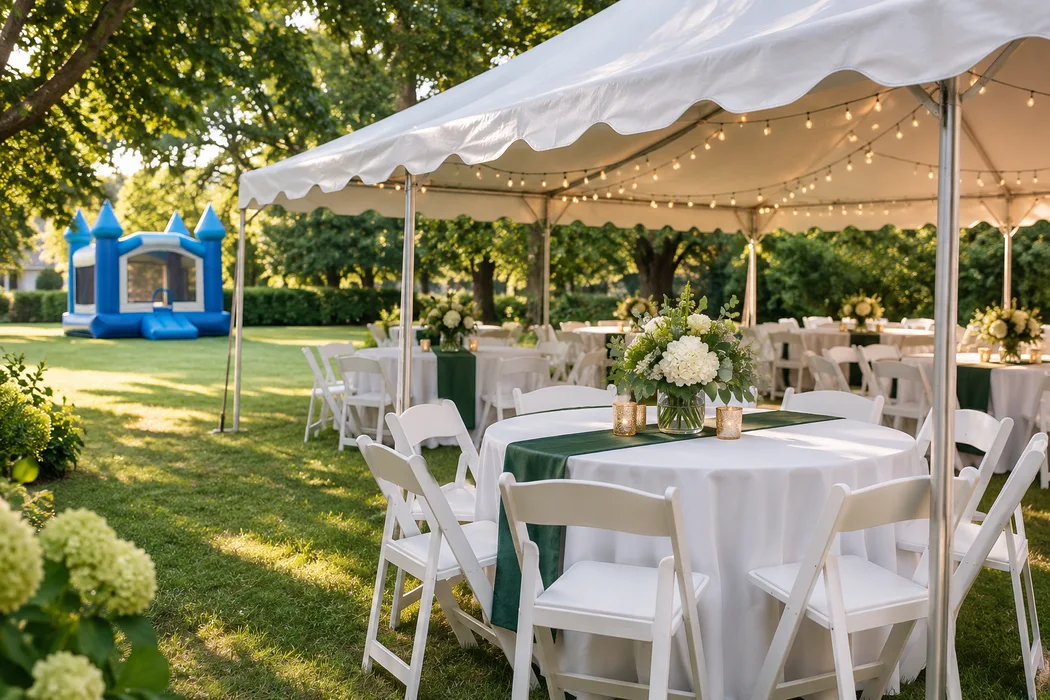
A party rental order looks simple until you follow it past the booking confirmation. Someone has to count chairs, load a vehicle, find the venue entrance, deliver within the agreed window, collect everything and get it ready before the next order. Your first offer should fit that whole sequence. If it only works when you skip the return labor or borrow a second vehicle at the last minute, it isn’t ready to sell online.
Start with an event you can serve repeatedly. The example in this guide is a 24-guest backyard gathering, served by a two-person crew with one vehicle and a small storage area. All prices, times and quantities below are illustrative. Replace them with measurements from your equipment, vehicle and market.
Define the party before you define the catalog
Pick one kind of customer and occasion. You might serve families hosting weekend birthdays, a venue with weekday business meetings, or neighbors holding small backyard gatherings. Each group buys something different. A family may care about delivery and setup, while a staffed venue might need the equipment staged by a strict load-in deadline and picked up after its own cleanup.
Talk to customers who have an actual date or have recently planned a similar party. Ask where it took place, how many guests attended, what they rented and which step required the most calls. Find out whether they expected the crew to set up or only deliver. Write down the words they use to describe a package. A customer asking for “seating for 24” may never look for four separate product pages and calculate quantities on their own.
Call a few venues you could reasonably serve. Ask what they need from vendors and whether their customers bring in furniture. Find out where crews can park and when a pickup is possible. If an attractive venue regularly requires an evening pickup after your crew is off duty, it may belong in a custom quote process rather than the first bookable offer.
Write an offer with a clear edge
Try a simple package of 24 chairs and four tables, with a standard delivery and collection window for addresses in your starting service area. Describe what you carry to the site, whether you place it in the agreed layout, whether tables must be empty at pickup and what conditions require a site review. Check your equipment dimensions against the layout you show. The package quantity does not, on its own, guarantee that the setup will fit any yard or venue.
Make the boundaries visible before taking a deposit. A customer should be able to tell which locations qualify, which hours they can choose and which changes require approval. Give customers an inquiry option for events outside those boundaries. This lets you learn about promising jobs while keeping uncertain requests out of the schedule until someone can review them.
Build the offer around what the stock can actually do
Write down the physical items in the package and their condition after a normal rental. Add handling equipment and anything the crew has to bring, even if the customer never sees a separate charge for it. A package may list just tables and chairs, while the truck still needs carts, protective covers and a way to keep different orders separate. Record which pieces belong to each order on the load sheet.
Watch for shared stock. If the same 24 chairs also appear as individual catalog items, both listings should draw from the same pool. Try a sample order that reserves the package while another customer asks for loose chairs for overlapping dates. Have someone verify that the warehouse and storefront show the same remaining count. If they don’t, keep that package in the review queue until the inventory settings match your actual stock.
Think about the equipment returned late, damaged or incomplete. Build time for unloading, counting and condition checks into the calendar. Set a process for holding damaged items and recording any substitutions. A count that includes chairs still out with another customer or awaiting inspection will mislead whoever takes the next booking.
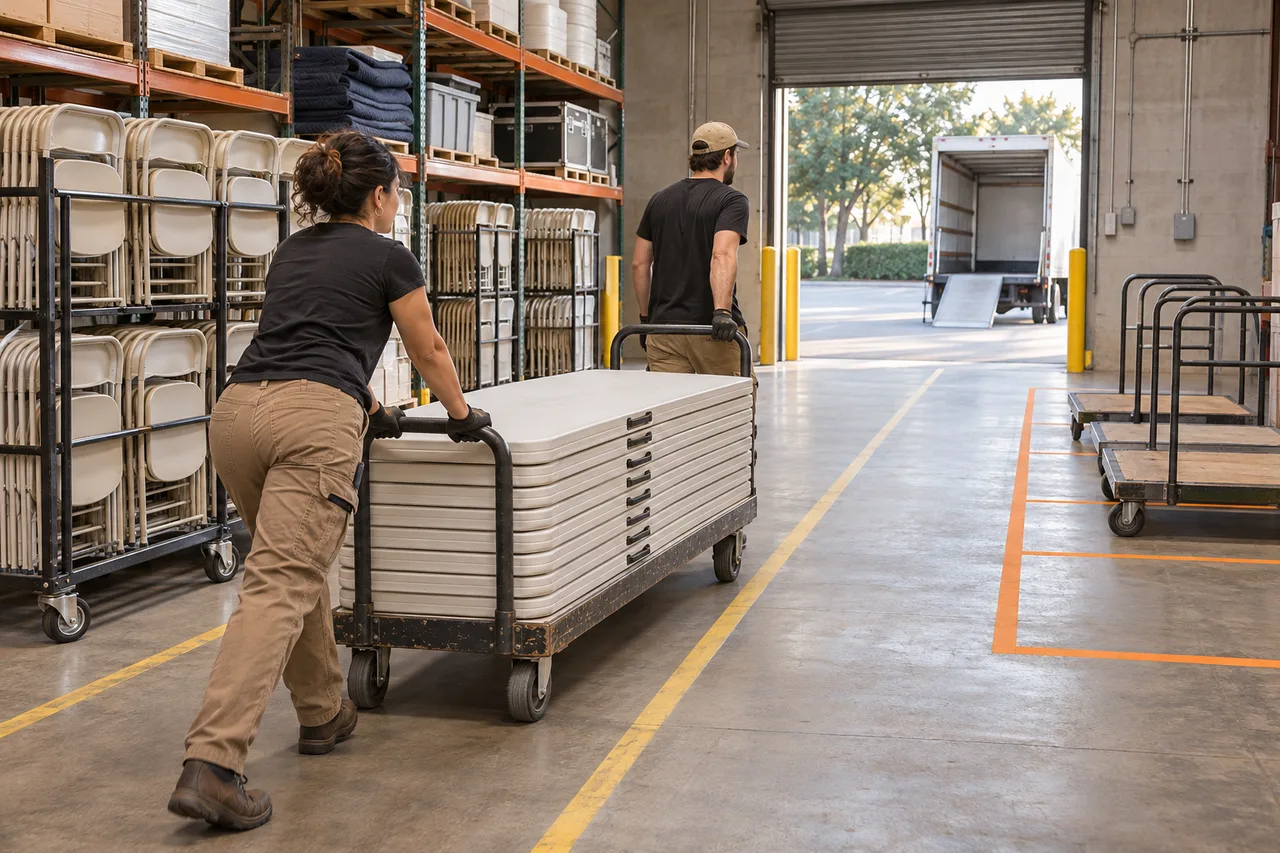
Walk the load in both directions
Stage the order in your storage space and load it as though an early delivery were booked. Time the process from retrieving items off the rack to closing the vehicle. At the destination, time how long it takes to find the right access, unload, and place the equipment where agreed. Repeat the exercise for pickup and return. Include the work of putting everything away, even if it happens after the customer has gone home.
Use the walkthrough to identify decisions workers need to make. For example, if chairs ride on two carts, mark how many are expected on each. If loading for two customers, label what goes to which stop and plan which equipment must come off first. The goal is for a crew that didn’t take the original call to recognize the order and know what counts as complete.
Calculate what the first few orders will cover
Build a cost estimate around one order rather than a general hourly target. In this illustration, the customer pays $320 for the package and standard delivery. The direct cost estimate allocates $96 to paid crew time, $34 to vehicle costs, $16 to cleaning and other supplies, and $10 to payment processing and minor incidentals. That leaves $164 to cover fixed costs, equipment recovery, owner pay and profit. These figures are examples, not market rates or fee estimates.
Then model a job that falls outside the standard plan. Suppose the venue requires a separate evening pickup that adds $65 in labor and vehicle time. If you charge the same $320, contribution drops from $164 to $99. That may still work for one nearby customer, but it’s a different offer. Decide whether the website should quote that service separately or send it to a coordinator before confirming.
Now add monthly costs the first package needs to support. If the example operation has $820 in fixed costs and you allocate the full amount to this package, five completed standard orders would cover that amount at $164 per order. That break-even check excludes equipment recovery and owner pay unless you explicitly include them. The Small Business Administration’s break-even calculator explains the same fixed-cost and per-order contribution calculation.
Record time even when the owner does the work
An owner might deliver personally in the first month and treat that labor as free. Track it anyway. If you later pay staff to do the same work, the offer needs to support that cost. Record who worked, when they started loading, how long travel took, and when the equipment was ready for the next order. Track the owner’s quoting and scheduling time separately from work at the venue.
Keep cash flow separate from profit. If guests book a month in advance and pay a deposit, the business may receive cash before it performs the work. Fuel, storage and purchase payments can have different due dates. Maintain a simple view of incoming amounts and outgoing commitments so you know how much money you’ll need to complete the orders already booked.
Open a calendar based on the tightest part of the day
Pick the departure, setup and collection windows you can reliably support with the same crew. It helps to schedule from the time the customer needs the equipment ready. If setup takes 35 minutes, the parking and walk to the site take 15, and you want a 20-minute buffer, the vehicle needs to reach the address 70 minutes before the promised ready time. Confirm those assumptions on a real route.
Try putting two orders on the same Saturday. Include vehicle load capacity, time to reach the second address and whether returning to the warehouse is necessary. Check the pickups too. Two deliveries can fit a morning even when their return windows conflict. Open the number of slots you can realistically finish, rather than the number of packages you can technically put in the cart.
Practice what staff should say when the design breaks. If a customer requests a different location after paying, check access, travel and availability before agreeing. If a yard isn’t accessible at the promised time, give the crew a central contact who can discuss a change with the customer. Update the booking so the next person sees the agreed instructions.
Put the same information where both teams need it
The customer confirmation needs the package contents, arrival window, payment deadlines, and a contact for changes. The crew’s record needs equipment counts, access instructions, the contact at the site and any notes that affect setup or pickup. Both should refer to the same order and the same agreed schedule. Avoid promises that exist only in an employee’s text messages.
Run a rehearsal where you increase the quantity shortly before dispatch. Check that the quote, warehouse count and delivery notes are all current. If the office sends a revised price but the crew receives yesterday’s packing sheet, fix the handoff before opening additional dates. Make it easy to see which version the customer accepted.
Use the first three jobs to learn what to change
Keep the first orders small enough that someone can observe the process. After each job, write down the price, direct cost, actual hours and anything that made the schedule slip. Review which questions the customer still asked after reading the offer. Add answers to the booking page when the questions affect whether an order is a fit. Save the details that matter only to staff in the crew instructions.
Use a short comparison after three jobs:
- Quoted versus actual crew time, including return and inspection.
- Contribution after direct costs, with unusual site charges listed separately.
- Requests declined because of equipment, staffing, distance or time windows.
- Differences between the pickup count and the expected equipment count.
- Questions customers asked about delivery, setup, changes or payment.
- The point where an owner had to intervene, and what information would have allowed staff to handle it.
Pick one improvement before adding a new package. If loading takes too long, try a staging area or a simpler kit and measure the time saved. If inquiries repeatedly ask for 32 seats, confirm your crew can fulfill that size before buying more stock. If people want a different kind of event altogether, put it into the same cost and scheduling exercise before deciding it belongs in your catalog.
Use the same package at two different venues
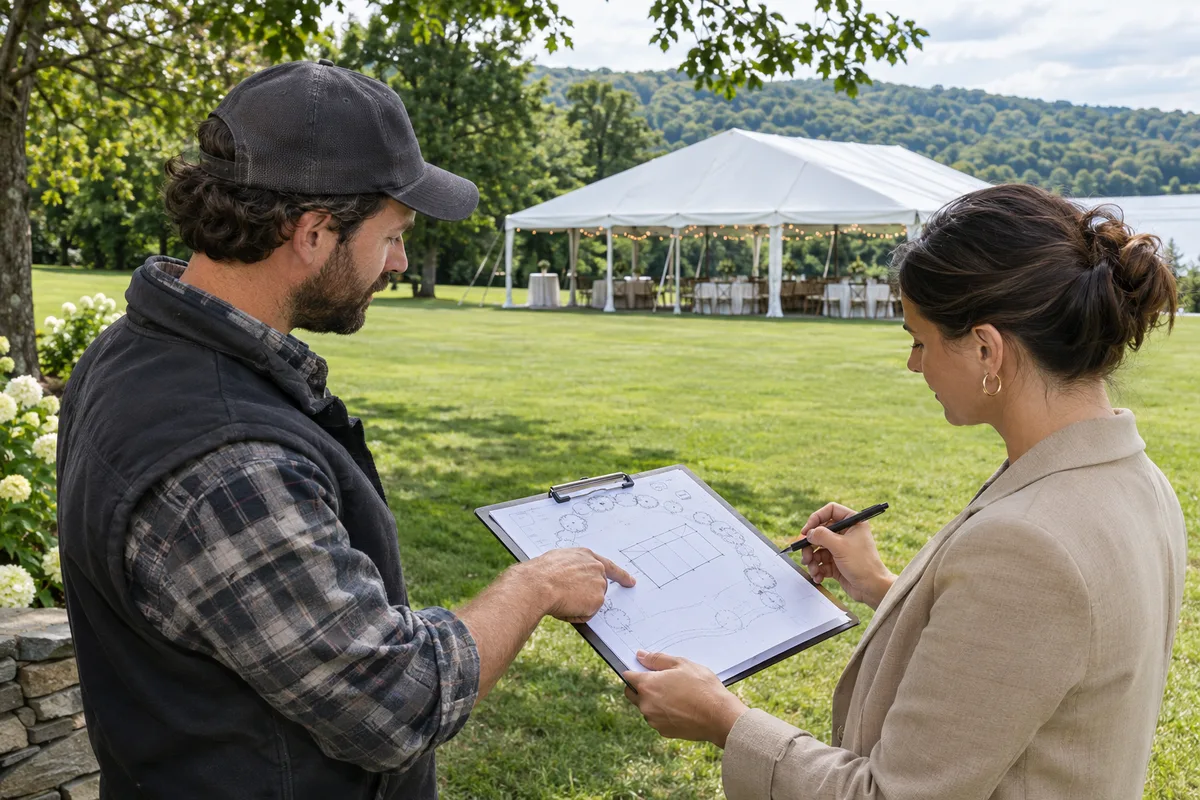
Test the package with two venue profiles before making it your default. For a backyard party, assume the host can meet the truck when it arrives and the crew can carry equipment directly to the setup area. For a community hall, assume there is a loading door, a tight access window, a facility contact and a deadline for getting the equipment out. Write one plan for each and put the plans beside the original quote. Look for work the salesperson promised without budgeting time to do it.
For example, suppose a seventy-minute service slot covers a fifteen-minute drive from the previous job, thirty-five minutes of unloading and setup, and twenty minutes of margin for a count and handoff. At the hall, the access instructions require the crew to enter through a staffed gate and take a freight elevator. Map each step using information the customer or venue can confirm. If the elevator can add twenty-five minutes and there is no legal or practical staging space outside, the job probably needs a different slot. It may still be profitable with a later install, an earlier delivery, or a fee that covers extra staffing. Add the exception to the quote while there is room to change the plan.
Use an exact minimum checklist during sales: a reachable contact, confirmed access, location of setup, room for the vehicle and a collection plan. The customer may only be able to confirm some details on the first call. Give them a deadline and tell them what decision depends on the answer. For example, “Please confirm the freight-elevator time by Wednesday so we can hold your delivery window.” Leave that follow-up in the booking record instead of relying on the person who took the call to remember it.
Check how the promise survives a handoff
Ask a crew lead who did not write the offer to interpret a sample booking without your help. Give them the products, setup plan, schedule and access messages they would normally see. Ask what they would pack, when they would leave and what condition they expect on arrival. If their answers differ from yours, trace the discrepancy to one missing instruction or ambiguous field. Clarify it in the quote, the booking record or the crew checklist depending on who needs to act on it.
When both venue trials are finished, review the price and the work together. Count travel, setup, teardown, extra communication, and cleanup. If the hall took forty more minutes, identify whether better instructions could have removed any of the delay. If the additional work always occurs, revise the affected package rule. Explain that rule in terms the host can recognize, such as whether the crew must use a freight elevator or meet a facility access window. The objective is to keep the ordinary offer simple and make venue-specific work visible before either party commits.
Questions to settle before taking orders
Should I offer both pickup and delivery?
Estimate the real work for each. Pickup may reduce travel but still requires a staffed handoff, space to load and clear expectations about equipment responsibility and return. Delivery may be easier for the customer if access is simple and jobs can share a route. Pilot the option you can run reliably, then use actual inquiry and order records to decide whether to add the other.
How do I handle a venue that requires proof of coverage?
Ask for the venue’s requirements early and share the event details with your qualified insurance professional. Keep the approved documents with the reservation and note who has to provide them and when. If you can’t confirm the arrangement, keep the quote provisional and make the next step clear to the customer before committing equipment or labor.
Do I need a full website before my first event?
You need a reliable way to explain the offer, collect the event details and confirm what the customer has agreed to. A focused product page and a clear quote or booking path can do that for a small pilot. Test it on a phone, check the messages the customer gets and fix the issues that would cause the wrong item or date to be booked.
When should I buy more equipment?
Look at why you’re turning away qualified orders. If the same size repeatedly sells out while crew and vehicle capacity remain available, more stock may solve a real problem. If you’re unable to fit another delivery window into the day, a new set of tables won’t make the trip shorter. Compare the direct contribution from the additional jobs with what the new equipment would cost to purchase, store and maintain.
Start with the package you can deliver, collect and prepare for another customer on a realistic schedule. When it keeps working as staff handle more of the handoffs, you’ll have the evidence you need to make the next investment.