A Better Packing and Return Checklist
Reduce missing accessories, damaged returns, and confused handoffs.
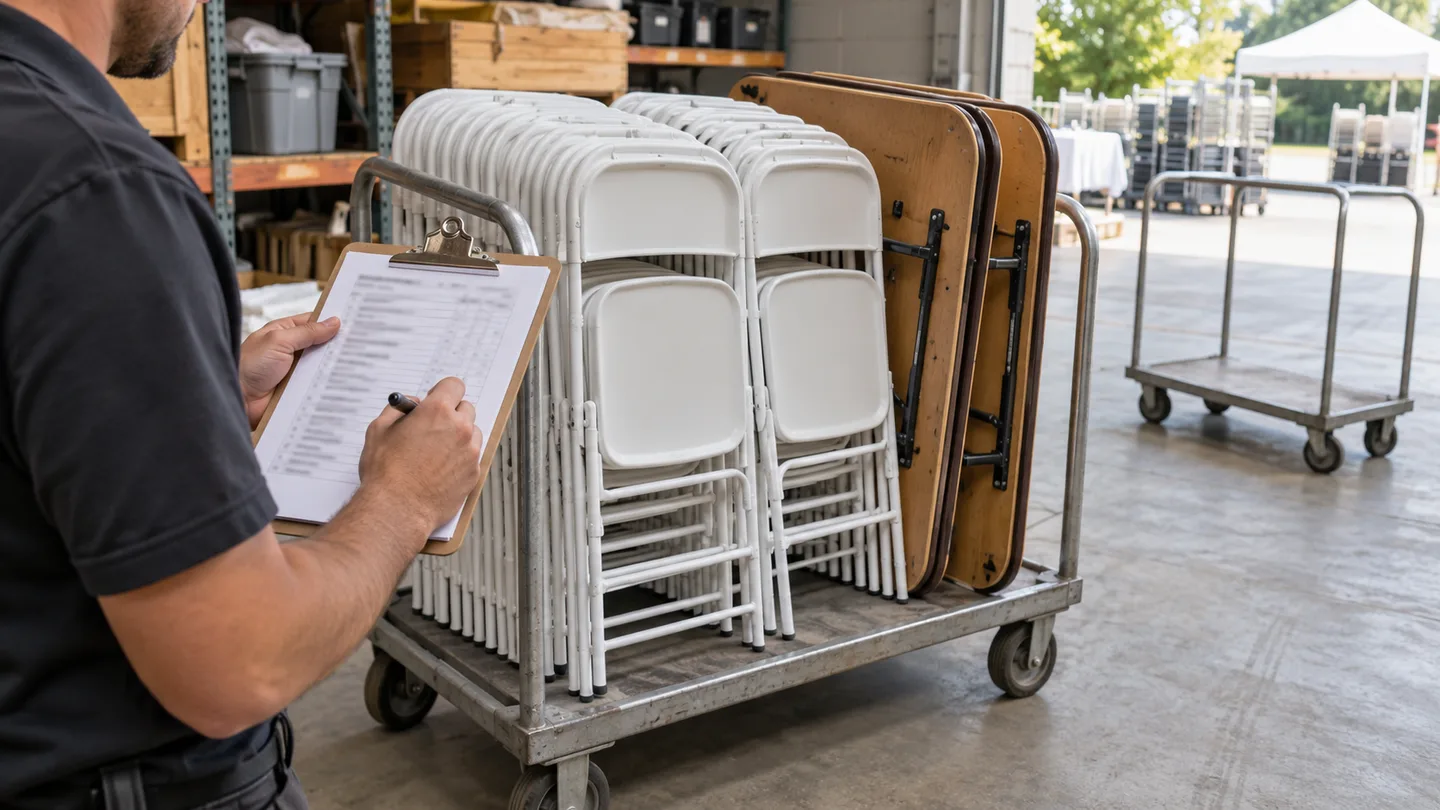
A table-and-chair order says sixty chairs. The warehouse loads six carts, each usually holding ten, and marks the truck ready. At delivery the sixth cart has eight. At pickup the crew finds fifty-seven chairs and sends a message to the office: “short three.” The office cannot tell whether all sixty ever left, whether a cart was miscounted, or whether two separate problems happened.
A useful checklist produces a record of what actually moved. It gives the next employee a reliable count, a place to record exceptions, and a way to find the equipment before the next order is due. Design it for three handoffs: packing to the delivery crew, the site back to the truck, and receiving to ready stock. The best place to test it is an ordinary load, because the busy days will expose any step that requires more writing than staff can reasonably do.
Start with a packing list the crew can work from
Create a separate list for each load. Put the booking reference, customer, location, scheduled handoff and person responsible at the top. Include only information the crew needs to identify the equipment and do the job. The truck does not need the full invoice or a copy of the customer's payment details. It does need the right location and a way to reach the contact when the loading door is locked.
Order the equipment lines by the way you pick in the warehouse. If chairs, tables and linens live in different bays, the sheet can follow that path. Include the product name, an identifier the picker can recognize, the staging location and the quantity needed. Keep quantities explicit when a package is broken into components. Staff can see the package name as a reference, but they need to know whether it requires six folded tables, sixty chairs, or a separate set of clips.
Decide which items deserve serial numbers or asset labels. Identical chairs can often be counted in bulk. A machine with a maintenance history or a specific power kit should be linked to the exact unit that leaves. Use identifiers already on the products or their transit cases. If a case label and the product inside can get separated, add a check that verifies both at packing.
Separate the planned quantity from the counted quantity
Give the picker one place for the requested count and another for the packed count. A checkmark can confirm that a line was actioned, but it cannot explain a gap. On the sixty-chair order, write “requested 60, packed 58, two held for replacement.” Add when the replacement will be brought to staging and who owns that next step. If the warehouse has a spare cart of verified equipment, update the line when the two chairs are added and confirm the final total before departure.
Use a quick label on mixed carts. A cart with eight chairs should say eight. If ten is the standard pack, allow the warehouse to record sealed groups or verified standard counts and require individual confirmation where the seal or group is broken. This keeps the process quick without treating the normal cart quantity as evidence. When the next crew takes the cart, they can see the batch count and which order it belongs to.
Give equipment a destination before loading
If a truck is serving three events, build each job in an identifiable staging area. Label carts, cases and wrapped bundles with the stop or order reference. Keep items being collected from a supplier separate on the sheet so a picker does not search your shelves for them. Put the route order on the truck copy. A crew that can identify the next stop's gear without opening every case is less likely to drop the wrong items at the right venue.
Choose how your team confirms the load at the truck. The picker can verify item totals by line and the crew lead can verify that the counted carts and cases are physically on board. These are different checks. A line can be fully staged and still miss the truck. Capture both if you have two people, or use two passes if the same person does the work. The handoff is complete once the next person knows the actual scope of the load and any unresolved exception.
Build a packing checklist around the common failure points
For each item, ask what would prevent the customer from using it. A table could be the wrong size. A box of battery-powered equipment could be missing a charger. A pallet holding several jobs could be short a case when it is split. Add a verification that catches the issue while the crew is still at the warehouse. If an error is obvious and harmless, it may need a label rather than another checkbox.
Walk through the checklist with one employee who knows the warehouse and one who does not. Give them the same sample order. Compare how they interpret language such as “accessories included” or “load ready.” Make it possible to confirm the actual condition. If the product requires a manual, model-specific accessory or a documented inspection, direct the worker to the applicable instructions. Responsibility for product safety belongs in the service procedure as well as the packing list.
A short checklist for this stage could read:
- Open the current order and confirm the stop, delivery window and warehouse staging area.
- Compare the physical items with the requested products, variants and quantities.
- Verify matched accessories and required equipment-specific checks.
- Record counts and assign unresolved differences to the person who can fix them.
- Identify each cart or case by stop and verify that it reached the vehicle.
- Hand the crew the latest site notes and the list of items that need a collection count.
Customize these lines to your operation. If your average order has two large pieces, write down their condition and identifiers. If your average load has three hundred place settings, make the checklist support sensible package counts and clear exceptions. The process needs enough detail to help someone else reconstruct what left on a given day.
Record the handoff at the venue
At delivery, note what was left and where. If the on-site contact asks the crew to take two extra chairs from the truck, determine whose inventory those chairs were allocated to before agreeing. Call the office or use the approved change process. Record any delivered substitution and whether the customer accepted it so the pickup team knows what to expect.
Photographs can help explain the layout or show the condition of a contested item. Use them where they add information, taking care with customers, private spaces and unrelated details. A timestamp and a clear note may be more useful than several indistinct photos. Recording the agreed return point is particularly important at venues with staff changes or multiple event rooms.
If the site has a late change or denied access, do not sign the sheet as a full delivery. Record what did happen. For example, the crew delivered forty chairs and held twenty on the truck pending access to the second room. Put the time and the affected items on the same booking. When the issue is resolved, record the second handoff. This lets the office see whether the next truck assignment is safe and whether the customer will have everything by the event start.
Decide what the crew can change
Make ordinary judgment calls easy. Staff can often document a different doorway, note the recipient, or split delivery into two counted batches. A paid add-on, a substitution affecting safety, or an agreement about extra rental time may require owner or office approval. Put the approval path where the crew can see it. They should know who to reach and what details the office needs to make a decision.
A shared record is more useful than a private text chain. If the crew uses a phone call during setup, copy the confirmed outcome into the booking afterward. Record what was authorized, who authorized it and when. Keep the record short enough to read on pickup. A good example is “After office approval, two extra gray folding chairs were delivered at 2:15 p.m., bringing the collection count to sixty-two.” The return crew can act on that line without finding the earlier messages.
Make pickup an independent count
Give the collection team the latest delivered quantities. Start with the inventory after approved changes, then take a new count before leaving. Mark what is coming back, what was left at the site, and what requires special handling on the vehicle. State the reason when an item is missing. It might be with another vendor, in a locked room, visibly damaged, or scheduled for a later pickup agreed with the office.
Suppose the sixty-chair load left the warehouse after the replacement was added, and two extra chairs were authorized on site. The collection crew expects sixty-two and counts fifty-nine. They find two in a secured room that the venue will open the next morning. The last chair is unaccounted for. The record should show fifty-nine on the truck, two pending at a named location, and one unresolved. Keep that classification through warehouse receiving so nobody treats all three chairs as permanently lost.
Handle a partial return before it becomes another shortage
Check which orders need the affected equipment next. If the missing item is a standard chair and a verified spare covers the next job, assign the spare and note the plan. If it is the only case with a specific product, schedule investigation before the warehouse starts preparing the next load. Record when another recovery or pickup attempt is due and who will follow up with the venue.
The driver's job is to capture what happened and call in urgent exceptions. Give the office responsibility for deciding how to handle rental terms, further trips or customer communications. Use the agreement and the documented facts. Avoid deciding at the truck whether a charge is owed. The person reconciling the order will need the delivered, collected, and received counts along with the relevant approval or site record.
Separate receiving from returning stock to service
A return can be in the warehouse while inspection is pending. Set up a receiving area with a place for equipment needing inspection, cleaning or repair. Attach the booking reference and note the reason. Make it obvious when a bin or cart is cleared for use. If a product is counted as ready before cleaning, charging or a condition check is complete, the next reservation can rely on equipment that is unavailable in practice.
At receiving, compare the vehicle count with the quantity physically unloaded. Look for obvious condition changes and decide which items need a closer check or specialist inspection. Update the reservation and the stock disposition using the same units as packing. If one damaged table is held aside, the booking may show all tables returned while the rentable stock remains one short. Tell the team who can clear that hold and where they will record the work.
A receiving worksheet can use five columns: item, expected at receiving, arrived, held or damaged, and released for rental. For a bulk line, the difference between arrived and released should have a reason. For an individually tagged asset, put the exact asset number next to the issue. A later repair note should be tied to that record. This lets employees see whether they are waiting on a customer, a driver, a cleaning shift or a repair.
Keep a simple end-of-day reconciliation
At closing, list items that left but are still outstanding and items in the building that are not ready. Compare those with the next morning's commitments. If there is an unresolved count, identify the last verified handoff and the fastest practical check. A buyer may be waiting for confirmation, or the morning crew may need permission to use a spare. Update the booking so that the overnight and morning teams see the same ownership and timing.
If the office and warehouse use different screens, agree which record owns current stock availability. Give each team a way to find the same quantities and a booking reference. Avoid passing around independent copies with no indication of when they were printed. A paper copy is still useful on the truck. Put a revision time on it and have a way to record changes so the person who checks equipment at return is using the latest verified counts.
Test the checklist with a difficult but ordinary order
Pick one order with a large bulk line, two distinct product variants, a model-specific accessory and one late collection. Walk it through your normal warehouse, truck, venue and receiving process. During the rehearsal, introduce three controlled exceptions: two items short at staging, one last-minute substitution, and a partial return. Ask the next person in each handoff to tell you what the last verified count is, what is still unknown, and who owns the next action.
Record how long the checklist adds and where it prevents repeated work. If staff have to fill out the same count in three screens, decide where the original record belongs and link the others to it if possible. If the warehouse needs a location field and the driver needs the venue handoff note, display the relevant information to each role. Add the smallest amount of detail that would have prevented the mistake. Then rerun the case with a different employee.
Review actual near misses after your first few busy days. Useful measures include the number of loads amended before leaving, the number of venue calls caused by incomplete notes, and the time a return spends waiting for inspection. Use the counts to narrow the checklist. If the most common issue is the wrong accessory, move that verification earlier. If accepted delivery changes frequently fail to reach the pickup crew, fix the handoff record. A checklist has done its job when the team can find the truth about the equipment while there is still time to act.
Give paper and offline records a simple return path
Decide what the crew should do when the warehouse connection is unavailable or a venue has poor coverage. Keep an ordered copy that includes the booking reference and revision time. Have the crew write actual counts and exceptions on it and name the person accepting the copy when they get back. If the record can be updated on a device offline, check that staff can distinguish a locally saved change from a synchronized one. A check performed next to the truck should reach the official reservation before the next shift relies on it.
If two copies disagree, review the handoff and keep both observations until the difference is resolved. Reconciliation is easier if each count names the person, time and location. An employee who received an unmarked stack of chairs should record that fact immediately and continue sorting rather than assigning it to the most likely booking. Once the warehouse identifies the job, attach the finding to the original exception and close it. That habit is especially valuable when two trucks collect similar equipment on the same evening.